
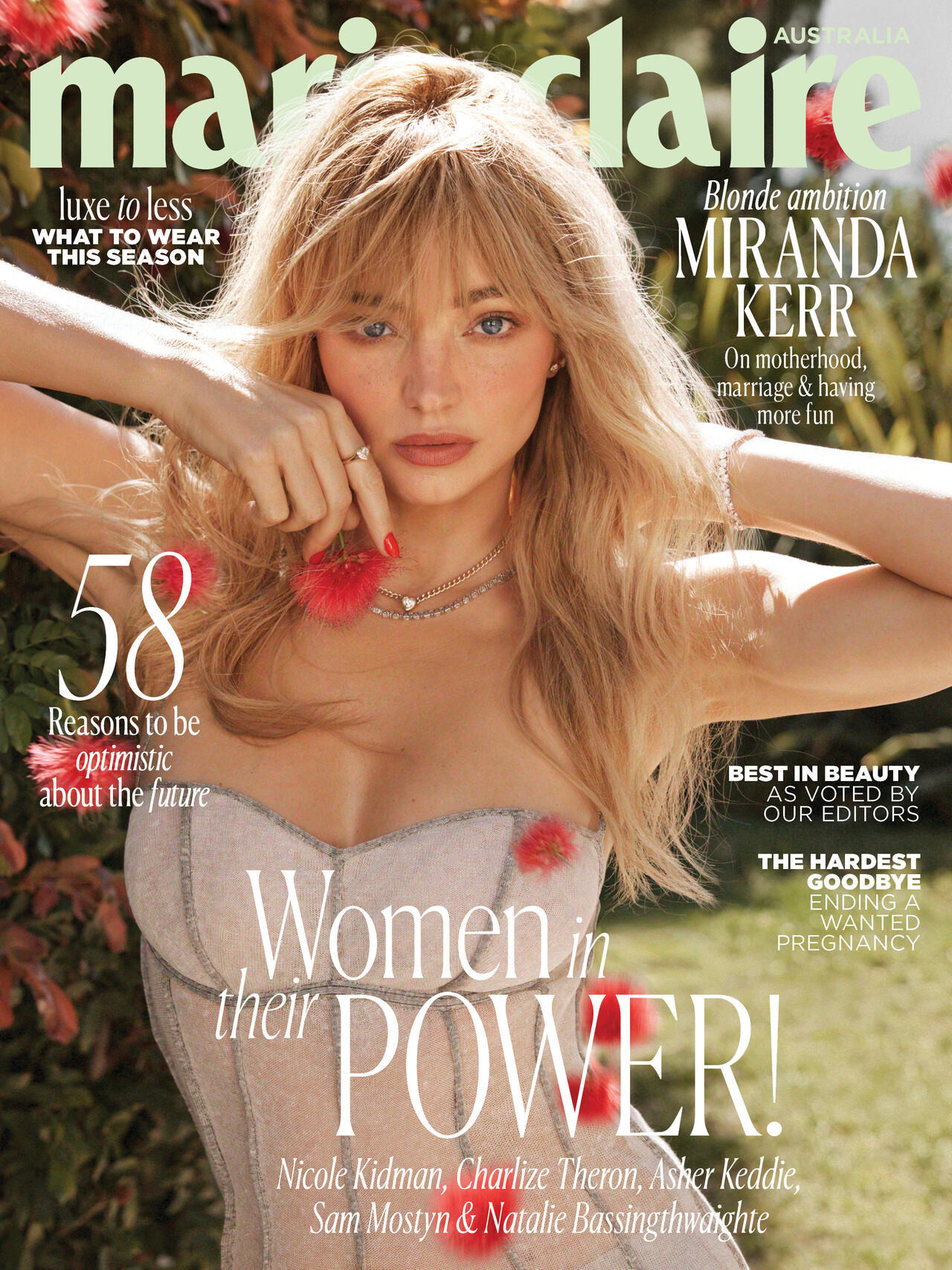
Marie Claire Australia April 2026 cover story editorial with Miranda Kerr (Model), shot by Greg Swales (Photographer), styled by Julianna Alabado (Wardrobe Stylist), with Nicole Konovaloff (Makeup Artist), Ericka Verrett (Hair Stylist).
+9
The April 2026 cover story of Marie Claire Australia positions Miranda Kerr within a carefully constructed duality: the hyper-disciplined wellness entrepreneur and the grounded, family-oriented figure whose identity has evolved far beyond the traditional contours of a supermodel narrative. Shot by Greg Swales and styled by Julianna Alabado, the editorial aligns visual polish with an underlying narrative of control, ritual, and continuity.
The setting—intimate, almost disarmingly so—immediately reframes Kerr’s public image. Rather than an untouchable figure, she appears embedded in a system of routines, technologies, and domestic structures. The presence of biohacking devices, from vagus nerve stimulators to circadian rhythm visors, signals a contemporary Los Angeles-coded pursuit of optimisation, but more importantly, it reinforces a key aspect of her persona: precision. This is not wellness as trend, but as methodology. Kerr approaches her physical and mental maintenance with the same rigor once applied to runway performance, particularly during her tenure with Victoria's Secret, where discipline and consistency were prerequisites for visibility.
That historical context remains crucial. Her trajectory—from being perceived as “too commercial” in Australia to replacing Gisele Bündchen as a Victoria’s Secret Angel—illustrates a recalibration of value within the fashion system. What was once dismissed became her defining leverage. Subsequent validation through associations with Nicolas Ghesquière at Balenciaga and campaigns for Prada and Jil Sander repositioned her within a more critically respected framework, but the editorial subtly suggests that Kerr’s real consolidation of power occurred outside of fashion imagery—through business.
Her skincare brand, KORA Organics, operates here not merely as an extension of her image, but as a parallel structure of authority. Maintaining a 95% stake underscores a rare level of control in an industry often dominated by conglomerates. The tension she articulates—being a “small fish in a big sea”—is less about scale and more about competitive density within the global skincare market. The strategic inflection point, driven by Evan Spiegel, reflects a shift from cautious brand-building to aggressive distribution, particularly through Sephora. This moment is critical: it marks the transition from founder-led authenticity to scalable enterprise.
Domestically, the narrative pivots toward structure and intentionality. Her role as a mother of four—shared in part with Orlando Bloom—is framed not sentimentally, but operationally. Rituals such as daily gratitude exercises and strict academic expectations function as counterweights to the socio-economic bubble of Los Angeles. This is not incidental; it mirrors her own upbringing in rural New South Wales, creating a deliberate contrast that informs her parenting philosophy.
The reference to the 2025 Palisades fire introduces a layer of external disruption, briefly puncturing the otherwise controlled environment. The involvement in recovery efforts through initiatives linked to Spiegel suggests an extension of their influence into civic or philanthropic domains, though the editorial does not overstate this dimension. Instead, it returns to internal stabilisers: meditation, faith, and routine.
Visually and sartorially, the collaboration is tightly aligned with this narrative. Under the direction of Nicole Konovaloff and Ericka Verrett, Kerr’s appearance—enhanced by the temporary shift to blonde—introduces a controlled variation rather than a radical transformation. Styling choices, including references to The Row and her jewellery collaboration with Michael Hill, reinforce a language of understated luxury: fluid silhouettes, restrained palettes, and pieces that prioritise wearability over spectacle.
The editorial’s strongest dimension lies in its articulation of longevity. Kerr’s relevance is no longer contingent on visibility alone, but on a multi-layered infrastructure: business ownership, disciplined self-management, and a recalibrated value system that privileges internal alignment over external validation. Her own reflection—shifting from being valued for exterior qualities to understanding her broader contribution—anchors this transition.
More News
If you liked Marie Claire Australia April 2026 Cover Story Editorial:
