
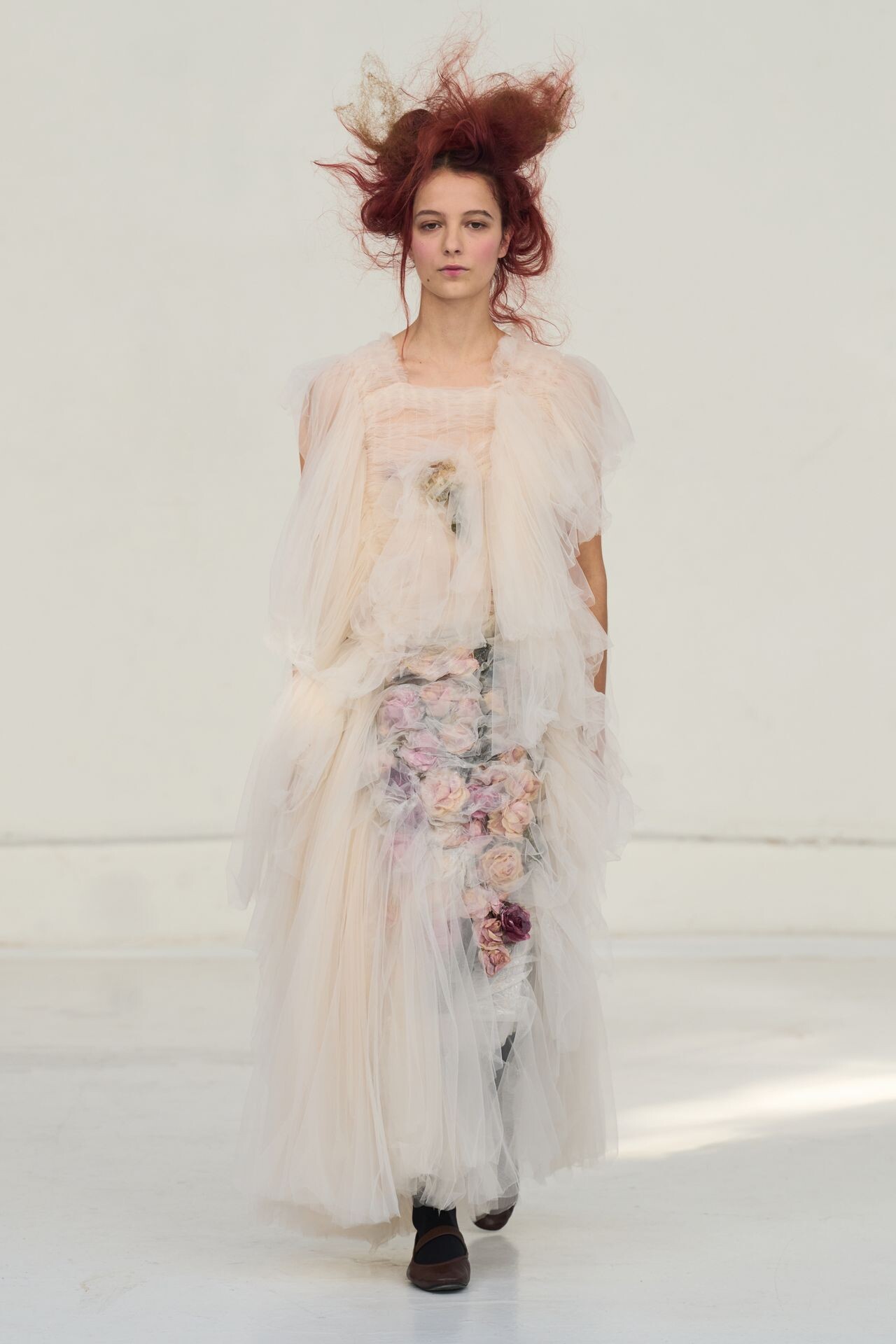
Caroline Hu Fall Winter 2026-2027 collection fashion show presented at Paris Fashion Week FW26 (March 4, 2026).
+12
Caroline Hu’s work often unfolds within a private, suspended universe, but for Fall Winter 2026–2027 that intimacy became strikingly literal. Backstage, the designer traced the origin of the collection not to literature or art history, but to a childhood towel she has kept into adulthood—handled so often it has softened into near-transparency. From that modest relic, she constructed a meditation on attachment, endurance, and the fragile architectures of memory.
The emotional register was pitched as nostalgia, though not in the conventional sense of romanticized retrospection. Instead, Hu approached it as an accumulation of tactile traces. A portrait collar appeared exaggerated and distressed, as though worn to the point of disintegration. A short bridal dress doubled as a miniature chapel, its hem faintly embroidered in burgundy to outline a door and nave. These gestures balanced innocence with quiet theatricality, proposing garments as repositories of sentiment.
Material treatment carried the narrative forward. Hand-frayed cotton mesh, silicone-coated faux florals veiled in tulle, and garments composed from a dozen disparate fabrics formed layered constructions reminiscent of mille-feuille. Peter Pan collars were built up through tuck-strip techniques and woven tapes, while pockets proliferated as if to physically contain memory. Lace, cotton, and silk—materials traditionally coded as delicate—were collaged into complex surfaces that subtly evoked 18th-century French undress without resorting to costume.
Hu’s experiments in volume introduced a structural counterpoint to this fragility. Suiting was inverted and rotated, transformed from rigid tailoring into swaying, multi-layered skirts. The gesture destabilized conventional hierarchies between masculine and feminine dress, but more importantly, it underscored her ongoing interest in garments that appear mid-metamorphosis. The silhouettes floated rather than asserted, their construction visible yet never raw.
Footwear provided an unexpected intervention. The much-maligned Bae Clog by Crocs was recontextualized through custom-knitted uppers and silk ribbon flowers. The clunky base remained intact, yet its surface was tenderized, folded into Hu’s romantic lexicon. It was an improbable pairing that nevertheless aligned with her broader thesis: even the most utilitarian object can be absorbed into a sentimental narrative.
Rather than conventional runway models, Hu enlisted dancers, led by actor-dancer-choreographer Emma Porter and movement artist Matt McCreary. Their performance blurred the boundary between presentation and theater. The garments did not simply circulate; they were inhabited, tugged, embraced, and carried across the stage in gestures that amplified their emotional charge. Fabric responded to motion, revealing its lightness and complexity.
The collection’s strength lay in its coherence of feeling. Hu translated a deeply personal object into a broader language of vulnerability and care, and the craft underpinning that translation was considerable. At times, the layering risked excess, with certain looks approaching ornamental saturation. Yet the underlying discipline—visible in the manipulation of volume and textile engineering—prevented sentiment from tipping into saccharine.
More News
If you liked Caroline Hu Fall Winter 2026-27 Fashion Show:
