
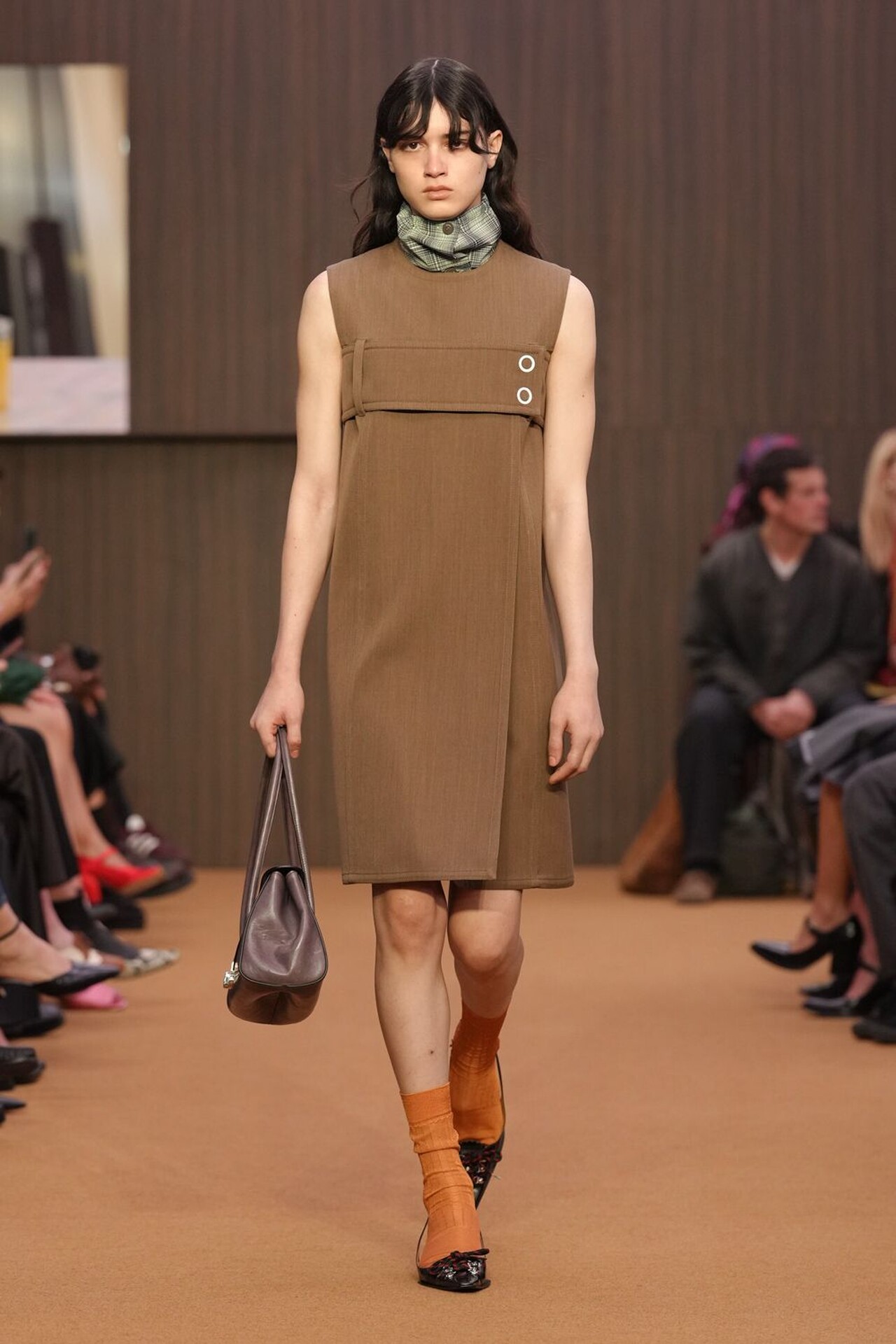
Marni Fall Winter 2026-2027 collection fashion show presented at Milano Fashion Week FW26 (February 26, 2026)
+56
Details
Closeups for Marni Fall Winter 2026-27 Fashion Show.
+95
Every house carries its own metaphysics: an aura shaped by founders, refined by successors, and sustained by the loyal gaze of its devotees. For Marni, that aura has always been artfully off-kilter—an alloy of Milanese rigor and cultivated eccentricity. With Fall Winter 2026-2027, the brand enters a new karmic cycle under Belgian designer Meryll Rogge, who assumes the mantle after the expressive tenure of Francesco Risso and the foundational vision of Consuelo Castiglioni. The shift feels less like rupture than realignment.
Rogge approached her debut with the reverence of a lifelong initiate. A self-declared Marni acolyte since adolescence, she excavated the house’s earliest collections—those austere seasons beginning in 1993 defined by white, black, brown, and gray. No prints. No embellishment. No decorative distraction. Just material integrity and sculptural clarity. That almost counterintuitive restraint resurfaced on the runway in a palette largely anchored in black and muted tones, with color deployed sparingly—pastel flashes or chromatic jolts that read as punctuation rather than proclamation.
The archival inquiry extended into the late ’90s and early 2000s, periods whose silhouettes remain surprisingly contemporary. What Rogge extracted was not nostalgia but proportion. The small, neatly cut coats; the fitted shoulders; the gently defined waists; the proper knee-length skirts—all signaled a silhouette both disciplined and quietly assertive. A skirt sitting slightly low on the hips became a structural anchor. Once that line was established, the collection unfolded through calibrated variation, each iteration reinforcing the sense that Rogge had located a stable foundation from which to build her Marni.
Her interpretation, however, introduced a subtle abrasion. Rogge leaned into a faintly punk inflection, aligning with Castiglioni’s historic resistance to anything overly pretty or sentimental. Garments were “toughened up” through hardware that oscillated between function and ornament—studs, fastenings, and metallic interventions treated as deliberate graphic accents. The gesture prevented the collection from drifting into preciousness.
Texture, long a Marni leitmotif, re-emerged with tactile conviction. Shearling and goat short coats delivered instinctive warmth, while furry surfaces nodded to house signatures without veering into caricature. Prints—another essential Marni code—were revisited with editorial precision. Stripes were brought forward with renewed graphic clarity. Dots reappeared as oversized discs loosely affixed to garments, creating kinetic sound and movement as models walked. Florals remained resolutely modernist: sharp, unsentimental, and free of decorative sugar. The overall effect preserved Marni’s hallucinatory streak, but in a controlled register.
Rogge was conscious of speaking simultaneously to connoisseurs and newcomers. Longtime adherents will recognize the archival signals embedded in proportion, palette, and print. Younger audiences may not parse the references, yet the expression feels contemporary rather than retrospective. That tension—between fidelity and forward motion—defines the success of the collection.
Central to Rogge’s thesis is a clear portrait of the Marni wearer: a woman with professional agency, cultural curiosity, and a life beyond fashion’s performative orbit. The same ethos extends to menswear—clothes for individuals who inhabit garments rather than pose in them. In 2026, such grounded sophistication reads as quietly radical.
Fall Winter 2026-2027 does not attempt to resurrect Consuelo’s Marni wholesale. Rogge acknowledges that such an act would be both impossible and undesirable. Instead, she proposes an adjacent evolution—rooted in archival discipline, sharpened by her own sensibility, and calibrated to the present. The result is a debut that feels measured, intelligent, and culturally literate: less a reinvention than a lucid continuation of Marni’s singular, offbeat modernism.
Videos
Videos for Marni Fall Winter 2026-27 Fashion Show.
More News
If you liked Marni Fall Winter 2026-27 Fashion Show:
